
Researchers planning a mixed methods study often face a practical question early in the design process: Do I need to conduct a power analysis? The answer may seem straightforward at first. In quantitative research, power analysis is widely accepted as a standard procedure for determining whether a study has enough participants to detect meaningful effects. However, mixed methods research introduces an additional layer of challenge by combining quantitative and qualitative approaches within a single study. This creates a tension between two research traditions that have historically relied on different assumptions about sampling and evidence. Quantitative researchers typically use statistical procedures to justify sample sizes, whereas qualitative researchers often assess sample adequacy by considering depth of information, data richness, and thematic saturation (Creswell & Plano Clark, 2018). When these approaches come together in a mixed-methods design, questions naturally arise about whether power analysis remains necessary, useful, or even appropriate.
Mixed methods research has become increasingly common across disciplines including education, health sciences, psychology, management, and social sciences. Researchers are drawn to it because it allows them to answer difficult questions from multiple perspectives. Quantitative data can reveal patterns, relationships, and trends, while qualitative data can provide explanations, context, and deeper insights into human experiences. As mixed methods research has gained popularity, expectations regarding methodological rigor have also increased. Funding agencies, ethics review boards, and journal reviewers often expect researchers to provide clear justifications for their sampling decisions. For many scholars, this expectation immediately raises the issue of statistical power, especially when the study includes surveys, experiments, or other quantitative components (Onwuegbuzie & Collins, 2007). Yet the presence of a qualitative component complicates matters. If one part of the study requires statistical justification and another does not, how should researchers defend their overall sample design? This question sits at the center of ongoing discussions within the mixed methods community.
The debate is often framed as a simple question: Is power analysis necessary in mixed methods research? In reality, the issue is far more nuanced. The answer depends on factors such as the purpose of the study, the role of the quantitative component, the chosen mixed methods design, and the intended use of the findings. Instead of treating power analysis as either mandatory or irrelevant, researchers may benefit from viewing it as one tool among several approaches for justifying sample decisions. Mixed methods research requires attention not only to statistical adequacy but also to qualitative depth and meaningful integration between data sources.
Understanding this distinction is important because it shifts the conversation from following methodological rules to making design decisions that fit the goals of a particular study. Before deciding whether power analysis is necessary in a mixed methods study, it is helpful to understand what power analysis actually does. Many debates surrounding its use stem from misunderstandings about its purpose and limitations. The next section examines the fundamentals of power analysis and clarifies what it can, and cannot, tell researchers about the quality of a study.
1. Understanding What Power Analysis Actually Addresses

What Power Analysis Is Really About
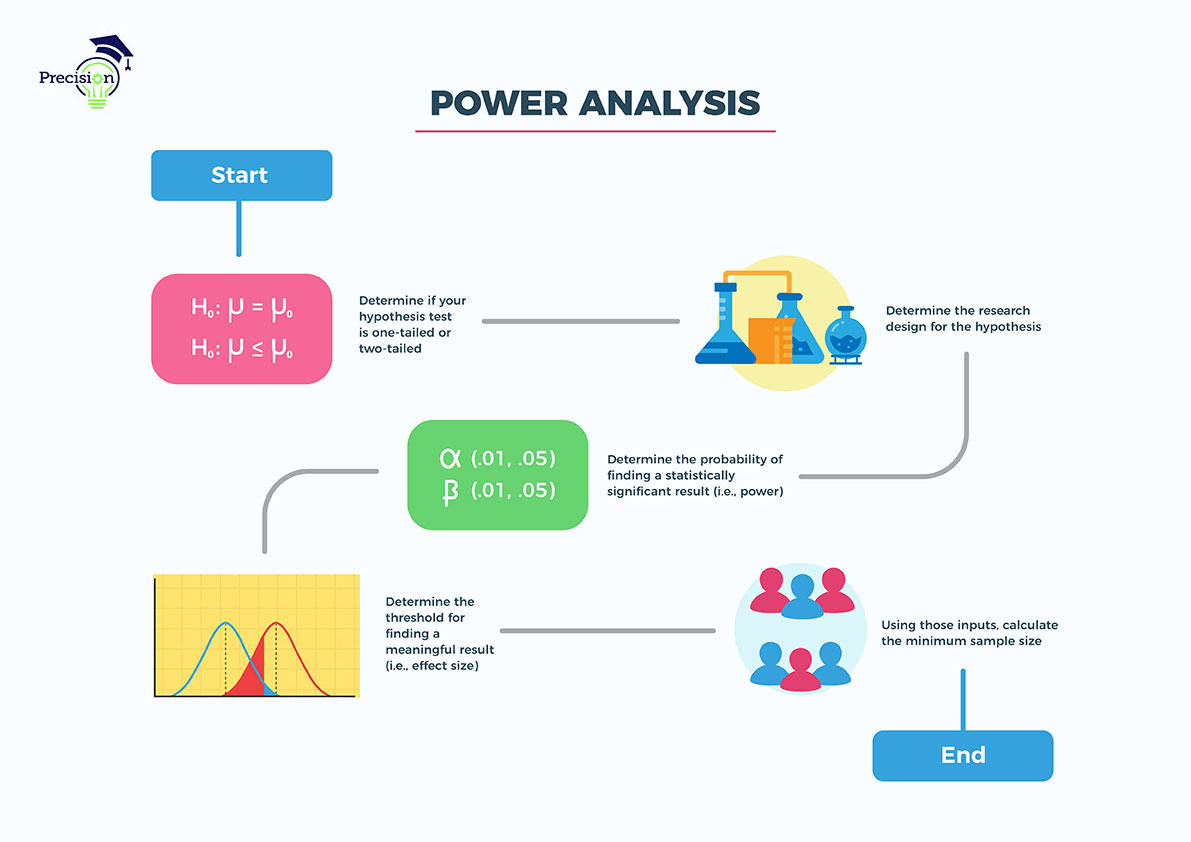
Power analysis is often mentioned in research proposals as if it is just a technical requirement. In reality, it answers a very practical question: Do we have enough data to reasonably detect the effect we are looking for? In quantitative research, this matters because a study may fail to find a result not because the result does not exist, but because the sample was too small to reveal it. Statistical power refers to the probability that a study will correctly detect an effect when that effect is truly present. Many researchers aim for a power level of .80, meaning the study has an 80% chance of detecting the expected effect if it exists (Cohen, 1988). This does not guarantee a meaningful finding, but it reduces the risk of missing one simply because the study was underpowered.
The Main Pieces of Power Analysis
Power analysis usually depends on four connected elements: sample size, effect size, significance level, and statistical power. Each one plays a role in shaping how sensitive a quantitative study will be. Sample size refers to the number of participants, observations, or cases included in the analysis. In general, larger samples make it easier to detect smaller effects. Effect size refers to the expected strength or size of the relationship, difference, or outcome being studied. A large effect is usually easier to detect than a small one. The significance level, often set at .05, reflects the researcher’s threshold for deciding whether a result is statistically unlikely to have occurred by chance. Power, finally, reflects the study’s ability to identify a real effect (Cohen, 1992). These elements work together. For example, if a researcher expects only a small effect, they will usually need a larger sample. If the expected effect is large, a smaller sample may be enough. This is why power analysis is not just about choosing a number. It is about aligning the research question, expected effect, and available data.
What Power Analysis Does Not Prove
One common misunderstanding is that power analysis proves a study is strong. It does not. A well-powered study can still have weak measures, poor recruitment, biased sampling, or unclear research questions. Power analysis only addresses one part of quantitative design: whether the sample is likely to be large enough for the planned statistical test. This distinction is especially important in mixed methods research. A power analysis may help justify the quantitative sample, but it says nothing about whether the qualitative interviews are deep enough, whether the themes are well developed, or whether the two strands of data are meaningfully integrated. Good mixed methods research requires more than statistical adequacy. It also needs thoughtful design, strong data collection, and clear integration between quantitative and qualitative findings (Creswell & Plano Clark, 2018).
Why Effect Size Matters So Much
Effect size is one of the most important parts of power analysis because it forces researchers to think about what kind of result would actually matter. A statistically significant result may not always be practically important. For example, a study with a very large sample may find a tiny difference between groups, but that difference may have little real-world value. This is why researchers are encouraged to think carefully about expected or meaningful effect sizes before collecting data. Effect sizes can come from prior studies, pilot data, theory, or practical judgment. Without this step, power analysis can become mechanical rather than meaningful (Lakens, 2022).
Why This Matters for Mixed Methods Research
In mixed methods studies, power analysis is most useful when the quantitative strand is expected to test hypotheses, compare groups, estimate relationships, or measure intervention effects. In these cases, researchers need enough participants to support the planned statistical claims. However, power analysis should not be stretched beyond its purpose. It does not determine how many interviews are needed. It does not measure saturation. It does not tell researchers whether participants’ experiences have been understood in enough depth. Instead, it helps answer a narrower but still important question: whether the quantitative part of the study is statistically prepared to do its job. Once researchers understand what power analysis actually addresses, the next issue becomes clearer: the quantitative component of a mixed methods study often carries its own expectations. The following section explores why this part of the design may still require formal power analysis, even when the overall study includes qualitative inquiry.
2. Why the Quantitative Component Often Requires Power Analysis

In mixed methods research, the quantitative part often does a specific job. It may test whether an intervention worked, compare groups, measure relationships, or estimate how common a certain pattern is. These are statistical claims, so they need statistical support. This is where power analysis becomes important. If the quantitative sample is too small, the study may fail to detect a real effect. That can lead researchers to conclude that “nothing happened” when, in fact, the study was simply not strong enough to show it. Cohen (1988) warned that low statistical power increases the chance of missing real effects, which can weaken the value of quantitative findings.
Reviewers and Funders Often Expect It
Power analysis is also practical. Many ethics boards, grant reviewers, dissertation committees, and journals expect researchers to explain how they decided on their quantitative sample size. In many cases, saying “we recruited whoever was available” is not enough. This does not mean every mixed methods study must have a large sample. It means the quantitative sample should match the quantitative purpose. If the study plans to run statistical tests, especially tests involving group differences or intervention outcomes, reviewers will usually want to know whether the sample is large enough to support those tests (Creswell & Plano Clark, 2018).
Underpowered Results Can Affect the Whole Study
In mixed methods research, the quantitative and qualitative parts are connected. A weak quantitative strand can affect the strength of the entire study, especially when the final interpretation depends on bringing both strands together. For example, imagine a study that tests whether a new teaching method improves student performance and then interviews students about their learning experience. If the test results are underpowered, the researcher may not be able to make a clear claim about whether the method worked. The interviews may still provide useful insight, but the integrated conclusion becomes harder to defend. This is why power analysis matters when the quantitative component carries weight in the final argument. It helps protect the study from building mixed methods conclusions on uncertain statistical ground.
It Helps Researchers Plan Before Collecting Data
Power analysis is most useful before data collection begins. It helps researchers think realistically about what they can test with the sample they are likely to obtain. This is important because some quantitative questions require more participants than researchers expect. For instance, detecting small differences between groups usually requires a larger sample than detecting large differences. Complex analyses may also require more data. Without planning, researchers may reach the analysis stage only to realize that their sample is too small for the claims they hoped to make. Lakens (2022) argues that sample size justification should be treated as part of responsible research planning, not as an afterthought. In mixed methods work, this planning is especially useful because researchers must balance time and resources across both quantitative and qualitative strands.
Power Analysis Supports Transparency
Another reason power analysis is useful is that it makes the researcher’s decisions clearer. It shows what assumptions were made about the expected effect size, statistical power, and significance level. Even when the final sample is smaller than planned, reporting the power analysis helps readers understand the study’s limitations. Transparency matters because mixed methods research often involves many design choices. Researchers decide which strand comes first, how much priority each strand receives, and how findings will be integrated. A clear sample size rationale helps readers see that the quantitative component was not added casually but was planned with its purpose in mind (Teddlie & Tashakkori, 2009).
When Power Analysis Is Especially Important
Power analysis becomes especially important when the quantitative component is central to the study. This includes experimental and quasi-experimental designs, group comparisons, surveys intended for statistical generalization, and studies testing relationships between variables. It is also important that the quantitative results will guide the qualitative phase. In an explanatory sequential design, for example, researchers may first collect quantitative data and then use qualitative interviews to explain the results. If the first phase is underpowered, the second phase may be built on unclear or unstable findings. Still, power analysis does not apply equally to every part of a mixed methods study. While it can strengthen the quantitative strand, it does not explain how qualitative sample sizes should be chosen. The next section looks at why traditional power analysis does not fit qualitative research and what researchers use instead.
3. Why Traditional Power Analysis Does Not Fit Qualitative Research

Traditional power analysis works well when a study is trying to test a statistical claim. It helps researchers decide whether they have enough participants to detect a measurable effect. But qualitative research usually works with a different purpose. It is less concerned with measuring how often something happens and more concerned with understanding how people experience, interpret, or make meaning of something. Because of this, qualitative sample size decisions do not follow the same logic as quantitative ones. A qualitative researcher may interview fewer people, but spend much more time exploring each participant’s story, context, and perspective. The goal is not to “power” the study statistically. The goal is to gather enough depth to understand the issue in a meaningful way (Patton, 2015).
Depth Matters More Than Numbers
In qualitative research, a larger sample is not always better. Sometimes, adding more participants can create more data without adding much new understanding. What matters is whether the data are rich, detailed, and relevant to the research question. For example, ten thoughtful interviews with people who have direct experience of a topic may be more useful than fifty short interviews with people who only have limited knowledge of it. This is why qualitative researchers often focus on purposeful sampling. They choose participants because those participants can provide insight into the phenomenon being studied (Creswell & Poth, 2018). This does not mean qualitative sampling is casual or weak. It simply follows a different standard. Instead of asking, “How many people do we need to detect an effect?” the qualitative researcher asks, “Who can help us understand this experience deeply?”
The Role of Saturation
One of the most common ways qualitative researchers justify sample size is through saturation. Saturation happens when additional data no longer bring in major new themes, ideas, or insights. In other words, the researcher begins to hear patterns repeated across interviews, observations, or documents. Guest, Bunce, and Johnson (2006) found that basic themes can sometimes appear within the first several interviews, though the exact number depends on the study design, population, and research question. This is important because it shows that qualitative sample size cannot be reduced to a universal formula. Still, saturation should not be used carelessly. It is not just a phrase to add to a methods section. Researchers need to explain how they assessed it, what kind of saturation they meant, and how it shaped their data collection decisions.
Power Analysis Cannot Measure Meaning
Power analysis is built for statistical testing. It does not tell us whether an interview captured a participant’s lived experience. It does not tell us whether a theme is well supported by the data. It does not tell us whether the researcher asked strong follow-up questions or interpreted participants’ words with care. That is why applying power analysis directly to qualitative research can be misleading. It may push researchers to think in numbers when the real issue is the quality and usefulness of the data. Qualitative rigor is usually judged through credibility, transferability, dependability, and confirmability rather than statistical power (Lincoln & Guba, 1985).
Qualitative Sample Size Still Needs Justification
Even though power analysis does not fit qualitative research, researchers still need to justify their qualitative sample size. A qualitative study should not simply say, “We interviewed a few people.” It should explain why those participants were appropriate, how they were selected, and how the final sample supported the purpose of the study. This justification may include the research design, the diversity of participants, the depth of the interviews, the dynamics of the topic, and whether saturation or information power was reached. Malterud, Siersma, and Guassora (2016) suggest that qualitative sample size depends on factors such as the study aim, sample specificity, quality of dialogue, and analysis strategy.
The key point is that qualitative research is not weaker because it does not use power analysis. It simply answers different kinds of questions and uses different standards for judging sample adequacy. This distinction becomes even more important in mixed methods studies, where quantitative and qualitative strands must be planned together. The next section looks at the challenges that arise when researchers try to apply power analysis within full mixed methods designs.
4. Challenges of Applying Power Analysis to Mixed Methods Designs

Applying power analysis in mixed methods research can be tricky because mixed methods studies do not all follow the same structure. Some studies collect quantitative and qualitative data at the same time. Others collect one type of data first and use it to shape the next phase. Some give more weight to the quantitative strand, while others place greater emphasis on the qualitative strand. This matters because power analysis only speaks directly to the quantitative part of the study. It can help estimate how many participants are needed for a statistical test, but it does not explain how many interviewees, focus groups, observations, or documents are needed for the qualitative strand. Mixed methods researchers therefore have to make two kinds of sample decisions, not just one (Creswell & Plano Clark, 2018).
The Two Strands May Need Different Sample Sizes
A common challenge is that the quantitative and qualitative components often require very different sample sizes. A survey may need hundreds of participants to detect a small effect or estimate a population trend. In contrast, a qualitative interview phase may involve a much smaller group because the goal is depth rather than statistical representation. This difference can confuse readers who expect one sample size to apply to the whole study. It can also create planning problems. Researchers may have enough people for interviews but not enough for statistical testing. Or they may have a strong survey sample but too little qualitative data to explain the findings in a meaningful way. In mixed methods research, the real issue is not whether both strands have the same number of participants. The issue is whether each strand has enough data to do what it is supposed to do.
Design Sequence Can Complicate the Process
Sequential designs create another challenge. In an explanatory sequential design, researchers usually collect quantitative data first and then use qualitative data to explain the results. Here, power analysis may be needed for the first phase because the qualitative phase depends on the strength of the quantitative findings. In an exploratory sequential design, the order is reversed. Researchers may begin with interviews or focus groups, then develop a survey or intervention based on what they learned. In this case, it may be difficult to run a precise power analysis at the start because the quantitative measures or hypotheses may not yet be fully developed. This shows why timing matters. Power analysis may be straightforward in some mixed methods designs, but less clear in others.
Integration Makes Sample Planning
Mixed methods research is not just about placing quantitative and qualitative findings side by side. The value of the approach comes from integration, or the process of connecting the two strands to produce a stronger overall understanding (Fetters, Curry, & Creswell, 2013). Power analysis does not address this integration directly. A study can have a well-powered quantitative sample and still fail as a mixed methods study if the qualitative strand is weak or if the two strands are never meaningfully brought together. Likewise, a rich qualitative strand may not rescue a poorly planned quantitative strand if the study’s main claims depend on statistical testing. This is why sample planning must consider the final mixed methods purpose, not only the needs of each strand separately.
Practical Limits Often Shape the Final Design
In real research settings, sample size decisions are also shaped by practical limits. Researchers may face small populations, limited funding, recruitment difficulties, short timelines, or ethical restrictions. These issues are especially common in health, education, and community-based research. When ideal sample sizes are not possible, researchers should be transparent. They can explain the planned power analysis, the actual recruitment outcome, and how the limitation affects interpretation. They can also adjust the study’s claims to match the evidence. For example, an underpowered quantitative phase may be framed as exploratory rather than confirmatory.
Mixed Methods Requires More Than One Sample Justification
The biggest challenge is that mixed methods research needs more than one kind of sample justification. The quantitative strand may need power analysis. The qualitative strand may need saturation, information power, or purposeful sampling logic. The integrated design may need a clear explanation of how both samples work together. This makes the methods section more demanding, but also stronger. Instead of forcing one sampling logic onto the entire study, researchers can explain how each part of the design supports the overall research question (Teddlie & Yu, 2007). These challenges do not mean researchers should avoid power analysis in mixed methods studies. They mean power analysis should be used carefully and only where it fits. The next section offers a practical framework for deciding when power analysis is necessary and how it can sit alongside qualitative sample justification.
5. A Pragmatic Framework: When Is Power Analysis Necessary?

The simplest way to decide whether power analysis is necessary is to ask one question first: What is the quantitative part expected to do? If the quantitative strand is testing hypotheses, comparing groups, estimating effects, or evaluating an intervention, then power analysis is usually important. In these cases, the study is making statistical claims, so the sample size needs a statistical justification. However, if the quantitative part is only descriptive or exploratory, the need may be less strict. For example, a small survey used to describe participant characteristics may not require the same kind of power calculation as a randomized trial. The key is to match the sample justification to the purpose of the quantitative data (Creswell & Plano Clark, 2018).
Use Power Analysis When Statistical Testing Drives the Study
Power analysis is most necessary when the quantitative results will shape the main conclusions. This includes experimental studies, quasi-experimental studies, group comparisons, regression models, and studies that aim to detect relationships between variables. In these designs, an underpowered sample can create a serious problem. The researcher may fail to find a real effect or may produce results that are too unstable to guide interpretation. Cohen (1988) emphasized that low statistical power increases the risk of Type II error, where a study misses an effect that actually exists. For mixed methods researchers, this matters because the qualitative strand may later be used to explain the quantitative results. If the quantitative findings are weak, unclear, or unstable, the whole mixed methods interpretation may become harder to defend.
Do Not Force Power Analysis Onto Qualitative Questions
A practical framework also requires knowing when power analysis does not fit. If the main goal is to understand experiences, meanings, processes, or social contexts, then qualitative sampling logic is more appropriate. In that case, researchers should focus on purposeful sampling, saturation, information power, or richness of data. For example, an interview phase may be justified by explaining why participants were chosen, how their experiences relate to the research question, and how the researcher determined that enough depth had been reached. Malterud, Siersma, and Guassora (2016) argue that qualitative sample size depends on the aim of the study, the specificity of the sample, the quality of dialogue, and the analysis strategy. This is a different kind of rigor. It is not weaker than power analysis. It is simply designed for a different kind of evidence.
Consider the Mixed Methods Design
The type of mixed methods design should also guide the decision. In an explanatory sequential design, where quantitative results come first and qualitative findings explain them, power analysis is often important for the first phase. The second phase depends on the clarity of the first. In an exploratory sequential design, where qualitative work comes first, power analysis may come later. The early qualitative phase may help define variables, develop instruments, or shape hypotheses. Once the quantitative phase is clearer, researchers can then decide whether a formal power calculation is needed. In a convergent design, where both strands are collected around the same time, researchers may need to justify each sample separately. The quantitative sample may be justified through power analysis, while the qualitative sample may be justified through saturation or information power.
Ask Whether the Study Is Confirmatory or Exploratory
Another helpful question is whether the quantitative strand is confirmatory or exploratory. Confirmatory studies test specific expectations. They usually need stronger sample planning because the researcher is trying to make a clear statistical claim. Exploratory studies are different. They may look for patterns, generate ideas, or inform later research. In these cases, power analysis may still be useful, but the researcher should be careful not to overstate the findings. Lakens (2022) notes that sample size justification should be transparent and tied to the goal of the study, rather than treated as a routine checkbox.
Be Transparent About Trade-Offs
Mixed methods research often involves trade-offs. A researcher may not have enough funding, time, or access to recruit the ideal quantitative sample. That does not automatically make the study useless. It does mean the researcher should be honest about what the study can and cannot claim. A strong methods section explains the planned sample, the actual sample, the reason for any shortfall, and the implications for interpretation. This honesty helps readers trust the study, even when the design has limits. In the end, power analysis is necessary when the quantitative strand needs it to support statistical claims. But it should not replace qualitative sample justification or mixed methods integration. The final section brings these ideas together and shows why the best answer is not simply “yes” or “no,” but “it depends on the role each part of the study plays.”
6. Conclusion: Moving Beyond an Either-Or Perspective
So, is power analysis necessary in mixed methods research? The most honest answer is: it depends. That may sound unsatisfying, but it is the answer that best fits how mixed methods research actually works. Power analysis is necessary when the quantitative part of the study needs to support statistical claims. If a researcher is testing an intervention, comparing groups, or examining relationships between variables, then sample size matters in a very direct way. Without enough participants, the study may miss real effects or produce results that are too uncertain to interpret with confidence.
The question of whether power analysis is necessary in mixed methods research does not have a universal answer. Its importance depends largely on the role of the quantitative component within the study. While quantitative strands often require power analysis to support statistical claims, qualitative strands rely on different principles such as data richness, saturation, and meaningful interpretation. Ultimately, strong mixed methods research recognizes that sample justification should align with the purpose of each research component rather than applying a single standard across the entire study. Researchers who take a balanced approach are better positioned to produce findings that are both statistically credible and contextually meaningful. By carefully justifying quantitative sample sizes through power analysis where appropriate and qualitative sample sizes through established qualitative methods, scholars can strengthen the overall rigor of their research. More importantly, they can ensure that quantitative and qualitative findings work together to provide a deeper understanding of complex research questions.
If you are struggling with sample size determination, power analysis, qualitative research, qualitative analysis, data interpretation, or any stage of your doctoral journey, our team is here to help. We provide expert dissertation help, personalized guidance from an experienced dissertation coach, and comprehensive dissertation consulting tailored to your research needs. Whether you need dissertation assistance, professional help with dissertation design and methodology, or full-scale dissertation services, our dedicated dissertation help service can support you from proposal development to final submission. Contact us today to move your research forward with confidence and expert support.
References
Cohen, J. (1988). Statistical power analysis for the behavioral sciences (2nd ed.). Lawrence Erlbaum Associates.
Cohen, J. (1992). A power primer. Psychological Bulletin, 112(1), 155–159.
Creswell, J. W., & Plano Clark, V. L. (2018). Designing and conducting mixed methods research (3rd ed.). Sage Publications.
Creswell, J. W., & Poth, C. N. (2018). Qualitative inquiry and research design: Choosing among five approaches (4th ed.). Sage Publications.
Fetters, M. D., Curry, L. A., & Creswell, J. W. (2013). Achieving integration in mixed methods designs: Principles and practices. Health Services Research, 48(6pt2), 2134–2156.
Guest, G., Bunce, A., & Johnson, L. (2006). How many interviews are enough? An experiment with data saturation and variability. Field Methods, 18(1), 59–82.
Lakens, D. (2022). Sample size justification. Collabra: Psychology, 8(1), 33267.
Lincoln, Y. S., & Guba, E. G. (1985). Naturalistic inquiry. Sage Publications.
Malterud, K., Siersma, V. D., & Guassora, A. D. (2016). Sample size in qualitative interview studies: Guided by information power. Qualitative Health Research, 26(13), 1753–1760.
Onwuegbuzie, A. J., & Collins, K. M. T. (2007). A typology of mixed methods sampling designs in social science research. The Qualitative Report, 12(2), 281–316.
Patton, M. Q. (2015). Qualitative research & evaluation methods (4th ed.). Sage Publications.
Teddlie, C., & Tashakkori, A. (2009). Foundations of mixed methods research: Integrating quantitative and qualitative approaches in the social and behavioral sciences. Sage Publications
Teddlie, C., & Yu, F. (2007). Mixed methods sampling: A typology with examples. Journal of Mixed Methods Research, 1(1), 77–100.